
Study Science in the Creation Week—Multi-level, Christian-based
Dr. Jay L. Wile starts with the creation week in Science In the Beginning for elementary students. It makes perfect sense to study science from the beginning as they discovered it. Written in a conversational teaching style, you can trust homeschool science books by Dr. Wile. [Read more about the features…]
Use Coupon Code CLEARANCE to save more on published clearance prices–while supplies last!
We are downsizing due to our upcoming retirement! Berean Builders is a great homeschool science curriculum. You can also purchase at the publisher: Berean Builders.
Item #SIBSET
Multilevel Grades K-6th

Science in the Beginning
9780989042413
Multilevel Grades K-6th
Science in the Beginning Set CLEARANCE
Item #SIBSET
Multilevel Grades K-6th
CLEARANCE
List $49.00
CLEARANCE $45.00

Science in the Beginning Set
Item #SIBSET
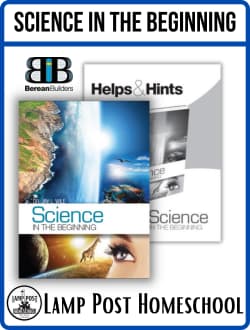
The Science in the Beginning Set includes one of each of the following items.
- Science in the Beginning Text [ ISBN-13: 9780989042406] is a hardcover textbook with beautiful photographs and sketches. It is fun to look at it. We like an appealing science book. The lessons are divided into six units of 15 lessons each. There are review lessons. It covers topics in order of the days of creation.
- Light and Energy topics for the first day of creation
- Water topics for day two
- Land, sea, and plants for day three
- Sun, moon, and stars for day four
- Invertebrates, vertebrates, sea animals, and birds for day five
- Land animals, people, and the five senses for day six.
- There’s a nice discussion of the seventh day of the creation week.
- In the last section of the book is a handy glossary. Learning new science vocabulary is important.
- Helps and Hints for Science in the Beginning [ ISBN-13: 9780989042413] features:
- Answers to the review exercises
- Hints to make some lessons easier
- Tests and answers for those who want to test their children
There are 90 lessons in this course. Instructions explain you can do lessons every other day if you want to include the optional challenge lessons or only twice a week if you don’t. Wisely, Dr. Wile leaves it to the parent to decide how many science lessons their children need. Students who have a talent for science will want to do the challenge lessons. Skipping the extras doesn’t interfere with regular lessons because the content in challenge lessons isn’t linked to the regular lesson content.
Each lesson has a hands-on activity that will engage your student. The reading part of the lessons is usually 1-2 pages. At the end of each lesson is a review. The review has three levels of questions: Youngest Students, Older Students, and Oldest Students. These are writing/journaling types of questions.
Younger students who aren’t writing yet could answer orally. If you want them to do some copy work, you could write the answer for them to copy into their notebook.
View samples at the publisher’s website:
- Text table of contents
- Text sample
- Lab supply list by lesson
- Consolidated lab supply list
- Scope and Sequence
- Printable Notebook (Older)
- Printable Notebook (Oldest)
Multi-Level for Grades K-6th
List $49.00
CLEARANCE $45.00
Helps and Hints for Science in the Beginning
Science in the Beginning
9780989042413
CLEARANCE
List $6.00
CLEARANCE $5.49

Helps and Hints for Science in the Beginning
ISBN-13: 9780989042413
In Helps and Hints for Science in the Beginning there are:
- Answers to the review exercises
- Hints to make some lessons easier
- Tests and answers for those who want to test their children
Softcover
List $6.00
CLEARANCE $5.49
Features of the Science Series by Dr. Jay L. Wyle
- Written in Dr. Wile’s conversational style with hands-on science activities.
- It’s a very homeschool-friendly program with a Christian perspective.
- Introduces science concepts as they were discovered in history is Dr. Jay L. Wile’s goal.
- Doesn’t it make sense to learn about scientific discoveries in chronological order—Coordinate your study of science with your study of world history.
- The first section of each text has simple instructions.
- Science In the Beginning has three levels of review for each lesson for students with different skill levels.
- Gather the easy-to-find supplies with the handy master supplies list.
- Teacher involvement is necessary for each course.
- You’ll need to direct the activities and read to or with the child(ren).
- Save teacher time by teaching several children at once.
- Participate in fun hands-on activities.
- Create homeschool memories with one-on-one interactions with your student.
- The beginning of history is given in the Bible’s creation account.
- Uses the days of creation as a way of introducing a wide range of scientific concepts including the nature of light, energy conservation, the properties of air and water, introductory botany, our solar system, basic zoology, and some aspects of human anatomy and physiology.
- As the students learn about these scientific concepts, they are constantly reminded of the Creator who fashioned the marvels they are studying.
Science Courses by Dr. Jay L. Wile, Berean Builders
Grades K-6
Revolution
Grades K-6
Grades K-6
Grades K-6